Featured publication
We are excited to see the latest publication released from the N2O-SSA project. Nitrous oxide (N2O) is a potent greenhouse gas and the largest ozone-depleting substance emitted this century, yet measurements across Sub-Saharan Africa remain extremely sparse. At the same time, improving food security across the region will require increased agricultural productivity and fertilizer use, making it important to understand how N2O emissions may respond. In this study, we compiled available field measurements from forests, grasslands and croplands across Sub-Saharan Africa and combined them with machine learning models to produce the first data-driven regional estimates of N2O emissions and identify the key environmental drivers controlling emissions.
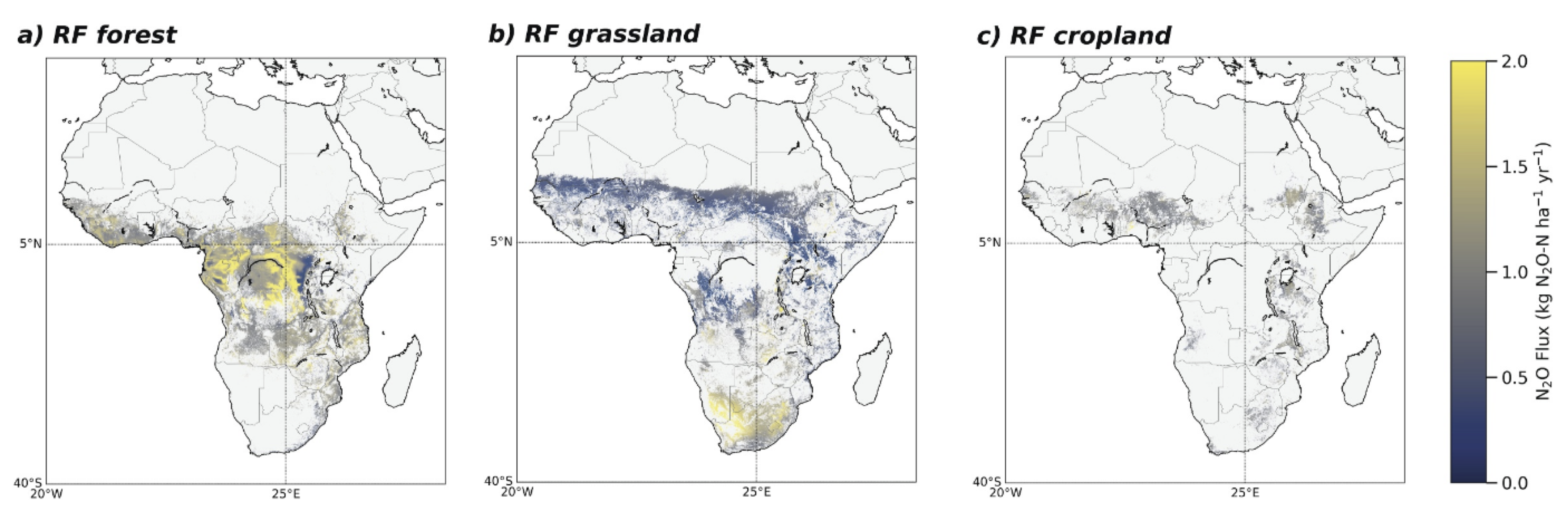
Modelled emissions from different land-use types in sub-Saharan Africa: Figure shows Sub‐Saharan African N2O‐N predictions for the baseline case using the random forest (RF)models for each land use.
The models suggest that emissions from grasslands, croplands, and forests in Sub-Saharan Africa currently contributes around 1–3% of global N2O emissions, with natural ecosystems accounting for most emissions today. Simulations indicate that severe climate change alone could reduce emissions from forests and grasslands because of drier soil conditions, while increased fertilizer use could substantially increase emissions from croplands. The study highlights both the importance of balancing food security with climate mitigation and the urgent need for expanded long-term N2O monitoring across Africa to improve regional and global greenhouse gas budgets.